

The Future of Remote Work: VR Offices in 2026
The Future of Remote Work: VR Offices in 2026, detailing technical specs, market trends, and 2026 predictions.
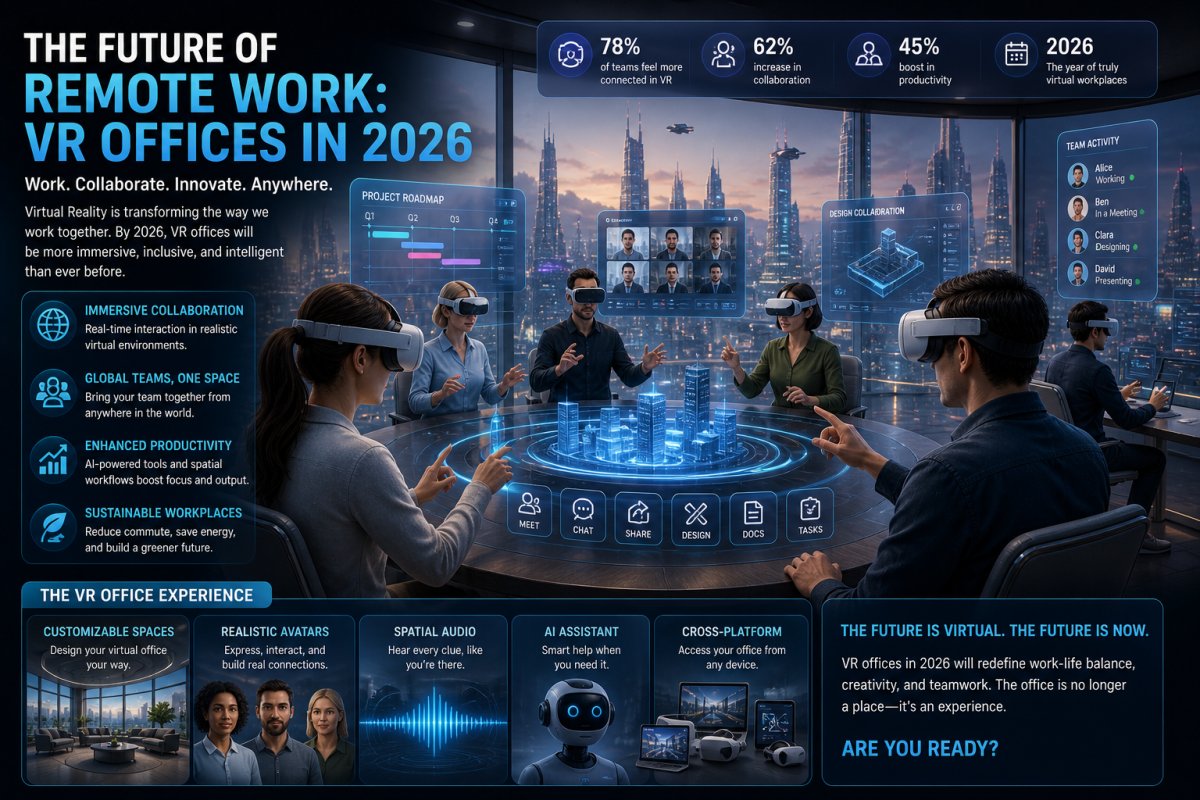
The Future of Remote Work: VR Offices in 2026
By mid-2026, the "Zoom fatigue" of the early 2020s has been replaced by a more immersive, spatial alternative. As
1. The Move to Spatial Productivity
In 2026, a VR office is no longer just a 3D chat room. It is a fully persistent digital workspace that mirrors the functionality of a physical office while removing its geographical constraints.
-
Persistent Environments: Unlike a video call that ends, a VR office persists. You can leave a "digital whiteboard" in a room, and it will still be there when you log back in the next day.
-
Spatial Audio: Using advanced HRTF (Head-Related Transfer Function) algorithms, sound in VR offices mimics real life. If a colleague is standing to your left in the virtual space, you hear their voice from the left, allowing for natural "side conversations" that are impossible on 2D platforms.
-
Haptic Feedback: High-end VR setups now include haptic gloves that allow users to "feel" digital objects, making collaborative design and physical prototyping much more intuitive.
2. Technical Integration: AI and Edge Computing
The success of VR offices in 2026 is built on the convergence of several key technologies we have discussed previously:
-
Edge Computing: To maintain the sub-20ms latency required to prevent motion sickness, VR offices rely on the
Node.js 2026 Roadmap -
Multiagent Coordination: Autonomous AI agents, a key
Gartner 2026 trend -
Avatars and Deepfakes: To ensure a professional look without the "uncanny valley" effect, companies use photorealistic AI avatars. However, this has led to increased security protocols to prevent
Deepfake impersonation
3. The Impact on Urban and Regional Hubs
The shift to VR offices is fundamentally changing the geography of work in India:
-
The Rise of Tier-2 Tech Cities: Professionals no longer need to reside in high-cost hubs like Bengaluru. Cities like Mysore are seeing an influx of "VR Commuters" who enjoy a higher quality of life while working in high-fidelity virtual spaces for global firms.
-
Reduced Carbon Footprint: With millions of daily commutes replaced by digital logins, 2026 has seen a measurable decline in urban carbon emissions.
-
Inclusivity: VR offices provide a level playing field for those with physical mobility challenges, allowing them to participate in a workspace that is entirely digital and accessible.
Technical Requirements for the 2026 VR Office
| Component | Minimum Specification | Recommended for 2026 |
| Connectivity | 5G / Fiber (100 Mbps) | |
| Chipset | 4nm Mobile XR Silicon | |
| Latency | < 30ms | < 10ms (Zero-Latency Motion) |
| Resolution | 4K per eye | 8K per eye (Retina Clarity) |
4. Security in the Virtual Workspace
As workspaces move into the cloud, the risk of
-
Biometric Authentication: Using iris scanning within the headset to verify identity.
-
Blockchain Verification: Utilizing
Ethereum 3.0 sharding
The Verdict
The VR office of 2026 is not about escaping reality; it is about enhancing it. It provides a solution to the isolation of remote work by restoring the "presence" of a physical office without the overhead of real estate.
What's Your Reaction?
 Like
0
Like
0
 Dislike
0
Dislike
0
 Love
0
Love
0
 Funny
0
Funny
0
 Wow
0
Wow
0
 Sad
0
Sad
0
 Angry
0
Angry
0












Comments (0)