

Top 5 Flutter Alternatives for 2026 Mobile Development
Top 5 Flutter Alternatives for 2026 Mobile Development, detailing technical specs, market trends, and 2026 predictions.
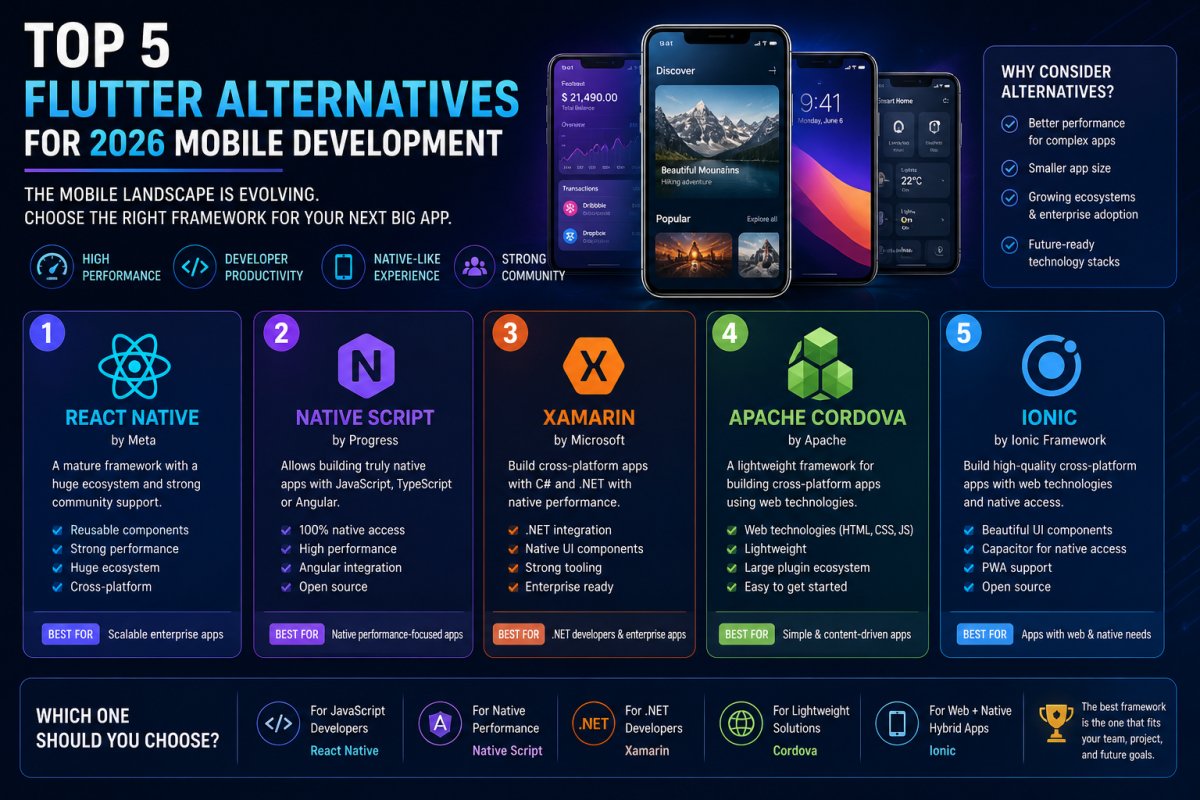
Top 5 Flutter Alternatives for 2026 Mobile Development
With the mobile landscape evolving toward more hardware-intensive applications—like those utilizing the 2nm chip architecture found in the OnePlus 14 Pro—choosing the right framework is critical for performance and scalability. While Flutter remains a powerhouse, several alternatives have gained significant ground in 2026 by offering better native integration or superior developer experience.
Here are the top 5 alternatives to Flutter for mobile development this year:
1. React Native (with New Architecture)
React Native continues to be Flutter’s biggest rival. In 2026, its "New Architecture" (Fabric and TurboModules) has fully matured, eliminating the "bridge" that once slowed it down.
-
Why it’s a top choice: It uses JavaScript/TypeScript, making it easy for web developers to transition to mobile.
-
Best for: Apps that require heavy use of social media APIs or complex JSON-based data structures.
-
2026 Edge: Seamless integration with Node.js backends, which is a core skill for modern full-stack developers.
2. Kotlin Multiplatform (KMP)
KMP has seen a massive surge in 2026 as developers move away from "UI-sharing" toward "Logic-sharing."
-
Why it’s a top choice: Unlike Flutter, which draws its own UI, KMP allows you to share business logic while keeping the UI 100% native.
-
Best for: High-performance apps where native look and feel are non-negotiable.
-
2026 Edge: It is the preferred choice for Android-first developers who want to expand to iOS without learning a new language like Dart.
3. Swift Data-Oriented Frameworks (Native iOS)
For developers focused on the premium Apple ecosystem, staying native is often better than using a cross-platform tool.
-
Why it’s a top choice: Direct access to Apple’s latest hardware features, such as advanced neural engines and ARKit.
-
Best for: High-end photography apps or forensic data tools that need raw processing power.
-
2026 Edge: Deep optimization for the latest iPhones ensures the lowest possible "Largest Contentful Paint" (LCP) for on-device apps.
4. .NET MAUI (Multi-platform App UI)
Microsoft's evolution of Xamarin has become a staple for enterprise-level applications in 2026.
-
Why it’s a top choice: It allows for a single codebase across Android, iOS, and Windows desktop, making it a true "universal" framework.
-
Best for: Internal business tools, monitoring dashboards, or inventory management systems (like laundry delivery trackers).
-
2026 Edge: Strong integration with Azure AI tools, perfect for building AI-driven newsrooms or automated monitoring systems.
5. Progressive Web Apps (PWA) with WebAssembly
In 2026, the line between "Web" and "App" has blurred thanks to advanced WebAssembly (Wasm) support.
-
Why it’s a top choice: No app store fees and instant updates. With Wasm, web apps can now run at near-native speeds.
-
Best for: Content-heavy platforms, news sites like NxTrendZ, or any service where SEO and quick discoverability are priorities.
-
2026 Edge: Perfectly complements high-performance servers running ea-php83, allowing for a unified web and mobile experience.
Summary Comparison for 2026
| Framework | Language | UI Type | Best Use Case |
| React Native | TypeScript | Native Components | Social Media & E-commerce |
| Kotlin Multiplatform | Kotlin | Shared Logic/Native UI | High-Performance Tools |
| Swift/Kotlin Native | Swift/Kotlin | Pure Native | Hardware-intensive apps |
| .NET MAUI | C# | Native Components | Enterprise & Desktop Sync |
| PWA + Wasm | JS/C++/Rust | Web-based | News & SEO-focused sites |
Which of these frameworks aligns best with your current tech stack—are you looking to stick with a JavaScript-based workflow or move toward a more native approach?
What's Your Reaction?
 Like
0
Like
0
 Dislike
0
Dislike
0
 Love
0
Love
0
 Funny
0
Funny
0
 Wow
0
Wow
0
 Sad
0
Sad
0
 Angry
0
Angry
0












Comments (0)