

Secure Kotlin: Shielding Apps Against 2026 Deepfake Threats
Secure Kotlin: Shielding Apps Against 2026 Deepfake Threats, covering tactical analysis, future trends, and expert insights for 2026.
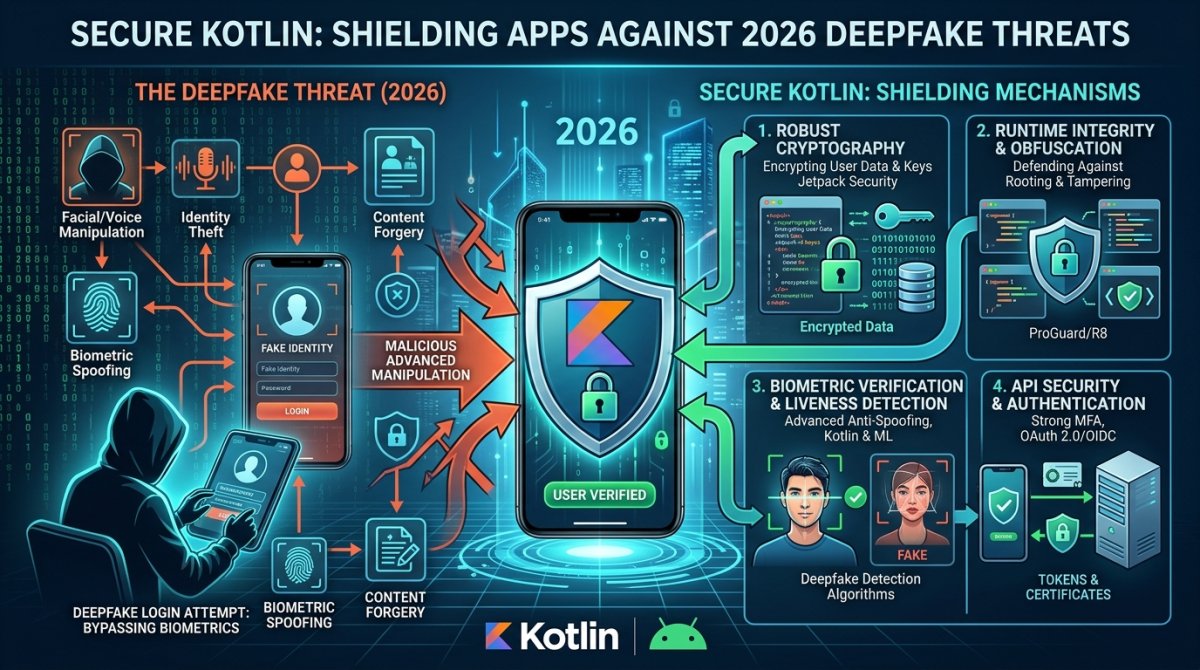
Secure Kotlin: Shielding Apps Against 2026 Deepfake Threats
As artificial intelligence moves from generating simple images to creating highly convincing, real-time video and audio, Deepfake threats have become a top-tier security concern in 2026. For developers building on Kotlin, whether for Android or Kotlin Multiplatform, implementing a "Zero Trust" architecture for media and identity is no longer optional.
1. Real-Time Liveness Detection
In 2026, static photo verification is easily bypassed by AI-generated avatars. Secure Kotlin apps must now implement Active Liveness Detection.
-
Challenge-Response Logic: Use Kotlin to programmatically challenge users to perform random actions—like blinking, turning their head, or saying a specific "nonce" (number used once)—during the KYC or login process.
-
Biometric Prompt API: Integrate the latest Android BiometricPrompt API, which in 2026 includes enhanced spoof-detection for 3D face mapping and sub-dermal pulse detection to ensure the subject is a living human.
2. Media Provenance and Metadata Verification
Deepfakes often lack the cryptographic "fingerprint" of a real camera sensor.
-
CameraX Security: When capturing media within your app, use the CameraX library to sign the image/video metadata at the moment of capture.
-
Hardware-Backed Keystores: Use Kotlin to store digital signatures in the device’s Trusted Execution Environment (TEE). This ensures that any video uploaded to your platform can be verified as "captured-on-device" rather than injected via a virtual camera or a deepfake bot.
3. Guarding Against Virtual Camera Injection
A common vector for deepfake attacks is the use of "Virtual Camera" apps that trick your application into accepting a fake video stream as a live feed.
-
Device Attestation: Utilize the Play Integrity API (or its 2026 equivalent) in your Kotlin code to check the integrity of the device. If the device is rooted or running a known "hooking" framework like Xposed, your app should automatically disable high-security features.
-
Input Validation: Implement strict checks to ensure the
CameraDevicebeing used is a physical, hardware-integrated unit and not a software-emulated peripheral.
4. Cryptographic Watermarking
As a video editor and web developer, you know that metadata can be stripped. Cryptographic watermarking embeds the verification data into the pixels themselves.
-
Pixel-Level Integrity: Use Kotlin's high-performance image processing libraries to embed invisible watermarks. If a deepfake AI attempts to alter the face in the video, the mathematical structure of the watermark breaks, instantly flagging the media as "Tampered."
5. The Developer’s Security Checklist for 2026
| Security Layer | Kotlin Implementation | Purpose |
| Identity | BiometricPrompt + CryptoObject | Prevents unauthorized AI-access |
| Network | Certificate Pinning | Stops "Man-in-the-Middle" AI-injection |
| Media | Hardware-signed Metadata | Proves the source of the video |
| Integrity | Play Integrity / Device Check | Blocks virtual camera software |
The Bottom Line
Protecting your users in 2026 requires a shift from "validating the data" to "validating the source." By leveraging Kotlin’s robust type-safety and deep integration with hardware security modules, you can ensure that NxTrendZ and your client projects remain resilient against the rising tide of AI-driven impersonation.
What's Your Reaction?
 Like
0
Like
0
 Dislike
0
Dislike
0
 Love
0
Love
0
 Funny
0
Funny
0
 Wow
0
Wow
0
 Sad
0
Sad
0
 Angry
0
Angry
0












Comments (0)