

India's Green Hydrogen Mission: 2026 Milestones Achieved
India's Green Hydrogen Mission: 2026 Milestones Achieved, detailing technical specs, market trends, and 2026 predictions.
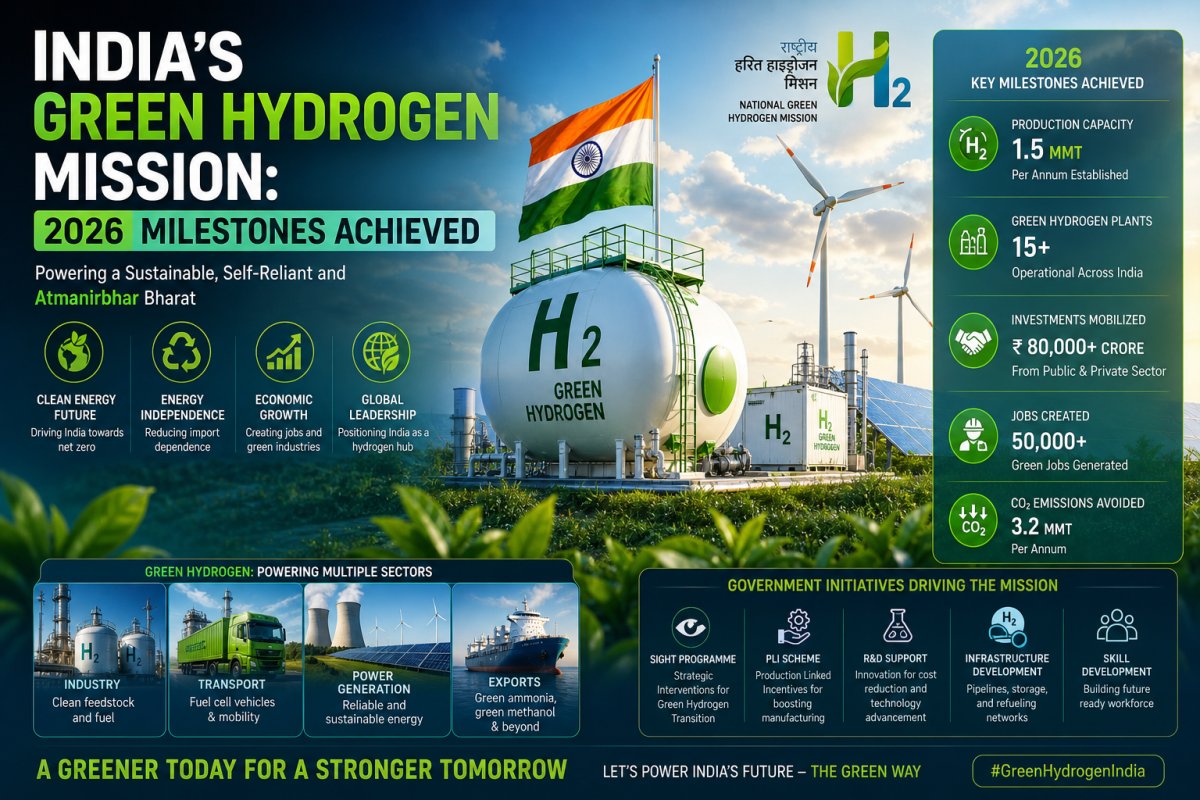
India’s Green Hydrogen Mission: 2026 Milestones Achieved
As of May 2026, India’s National Green Hydrogen Mission (NGHM) has transitioned from ambitious policy frameworks to tangible ground-level execution. Launched in January 2023 with an initial outlay of ₹19,744 crore, the mission aimed to position India as a global leader in the production, usage, and export of green hydrogen. By early 2026, the nation has surpassed several critical benchmarks in production capacity, cost-reduction, and sectoral integration, marking a decisive phase in its journey toward Net Zero by 2070.
1. Production Milestones: From Pilot to Kiloton Scale
One of the most significant physical milestones achieved by February 2026 is the commissioning of approximately 8,000 tonnes per annum (TPA) of green hydrogen production capacity. While this represents a fraction of the 5 Million Metric Tonne (MMT) target for 2030, it signifies the successful shift from theoretical discussion to operational reality.
-
Operational Facilities: Major megawatt-scale indigenous facilities have been commissioned at strategic locations, including the Deendayal Port Authority in Kandla and a port-based pilot at V.O. Chidambaranar Port.
-
Capacity Pipeline: Under the Strategic Interventions for Green Hydrogen Transition (SIGHT) scheme, 18 companies have been awarded a cumulative production capacity of 862,000 tonnes per year, currently in various stages of construction.
2. The SIGHT Programme: Breaking Global Cost Benchmarks
In early 2026, India achieved a breakthrough in commercial viability through the SIGHT programme. The Solar Energy Corporation of India (SECI) conducted competitive bidding for green ammonia supply, discovering prices that stunned global markets.
-
Price Discovery: Discovered prices for green ammonia ranged from ₹49.75 to ₹64.74 per kg.
-
Global Comparison: These prices are significantly lower than the global benchmark of approximately ₹110 per kg, proving that India can produce hydrogen derivatives at competitive rates even without heavy end-user subsidies.
-
Import Substitution: By displacing conventional fossil-fuel-based ammonia in 13 fertilizer units, India is estimated to save $2.5 billion in import bills over the next decade.
3. Manufacturing Sovereignty: Electrolyser Capacity
To ensure long-term energy security, India has prioritized the domestic manufacturing of electrolysers—the core technology needed to split water into hydrogen.
-
Awarded Capacity: 15 companies have been granted incentives to set up 3,000 MW (3 GW) per annum of domestic electrolyser manufacturing capacity.
-
Financial Incentives: A total of ₹4,440 crore has been allocated to these firms to de-risk the initial capital investment and encourage the "Make in India" initiative for green energy hardware.
4. Sectoral Decarbonization: Beyond Energy
By 2026, the mission has successfully integrated green hydrogen into "hard-to-abate" sectors that cannot be easily electrified.
Fertilizers and Refineries
Green hydrogen is now actively replacing "Grey Hydrogen" (made from natural gas) in critical industrial processes:
-
SECI has secured contracts for 7.24 lakh tonnes per annum of green ammonia for the fertilizer sector.
-
Refineries, including those of Indian Oil (IOCL) and Bharat Petroleum (BPCL), have discovered green hydrogen supply costs of ₹387 to ₹397 per kg (inclusive of GST) through competitive bidding.
Transport and Mobility
Hydrogen-powered mobility is no longer a futuristic concept in India:
-
Pilot Routes: 37 fuel cell and hydrogen internal combustion engine (ICE) vehicles have been deployed across 10 key pilot routes as of late 2025.
-
Shipping: Strategic port-based hydrogen facilities are being developed to support green shipping and refueling hubs for international trade.
5. Regional Leadership: The Gujarat Model
State governments have amplified the central mission. Gujarat, in particular, unveiled its Green Hydrogen Policy 2025, which held its first major regional conference in early May 2026.
-
Ambitious Targets: Gujarat aims for 3 MMTPA of green hydrogen production by 2035.
-
Infrastructure Support: The state is planning for 30 GW of electrolyser capacity and 75 GW of dedicated renewable energy capacity to feed these hubs.
-
Regulatory Framework: The state offers infrastructure support and financial incentives for both biomass-based and electrolysis-based projects to attract direct and indirect green jobs.
6. Strategic Imperatives and Challenges
Despite these milestones, 2026 has brought new challenges that require urgent attention. Former G20 Sherpa Amitabh Kant and other experts have noted that recent global supply chain disruptions (such as chokepoints in the Strait of Hormuz) have turned green hydrogen from a "climate goal" into a "national security imperative".
-
The Cost Gap: While SIGHT prices are low, the projected cost of green hydrogen by 2030 still sits between $3.0 and $3.75 per kg, which is nearly double the aspirational target of $1.5 per kg.
-
Infrastructure Constraints: Over 50 GW of renewable capacity sat stranded in 2025 due to grid limitations, highlighting the need for urgent transmission investment in the renewable corridors of Rajasthan and Tamil Nadu.
-
The CBAM Factor: On January 1, 2026, the EU's Carbon Border Adjustment Mechanism (CBAM) entered its definitive phase. With no exemptions found even after India-EU trade negotiations, Indian exporters of steel and aluminum must accelerate green hydrogen adoption to avoid heavy carbon taxes on exports to Europe.
Summary of 2026 Status
| Milestone Category | 2026 Achievement |
| Operational Production | ~8,000 Tonnes Per Annum (TPA) |
| Contracted Green Ammonia | 7.24 Lakh Tonnes Per Annum |
| Manufacturing Hubs | 3,000 MW Electrolyser capacity awarded |
| Investment Outlook | Expected to attract ₹8 lakh crore by 2030 |
| Environmental Impact | Projected reduction of 50 MMT CO2 per year by 2030 |
India’s Green Hydrogen Mission in 2026 is a testament to the country's "self-reliance" or Atmanirbhar Bharat strategy. By building a domestic ecosystem that includes mineral processing, battery manufacturing, and large-scale solar arrays, India is not just switching fuels; it is ensuring its energy sovereignty for the next century.
What's Your Reaction?
 Like
0
Like
0
 Dislike
0
Dislike
0
 Love
0
Love
0
 Funny
0
Funny
0
 Wow
0
Wow
0
 Sad
0
Sad
0
 Angry
0
Angry
0













Comments (0)