

Ethereum 3.0 Proposal: Sharding the Future of DeFi
Ethereum 3.0 Proposal: Sharding the Future of DeFi, detailing technical specs, market trends, and 2026 predictions.
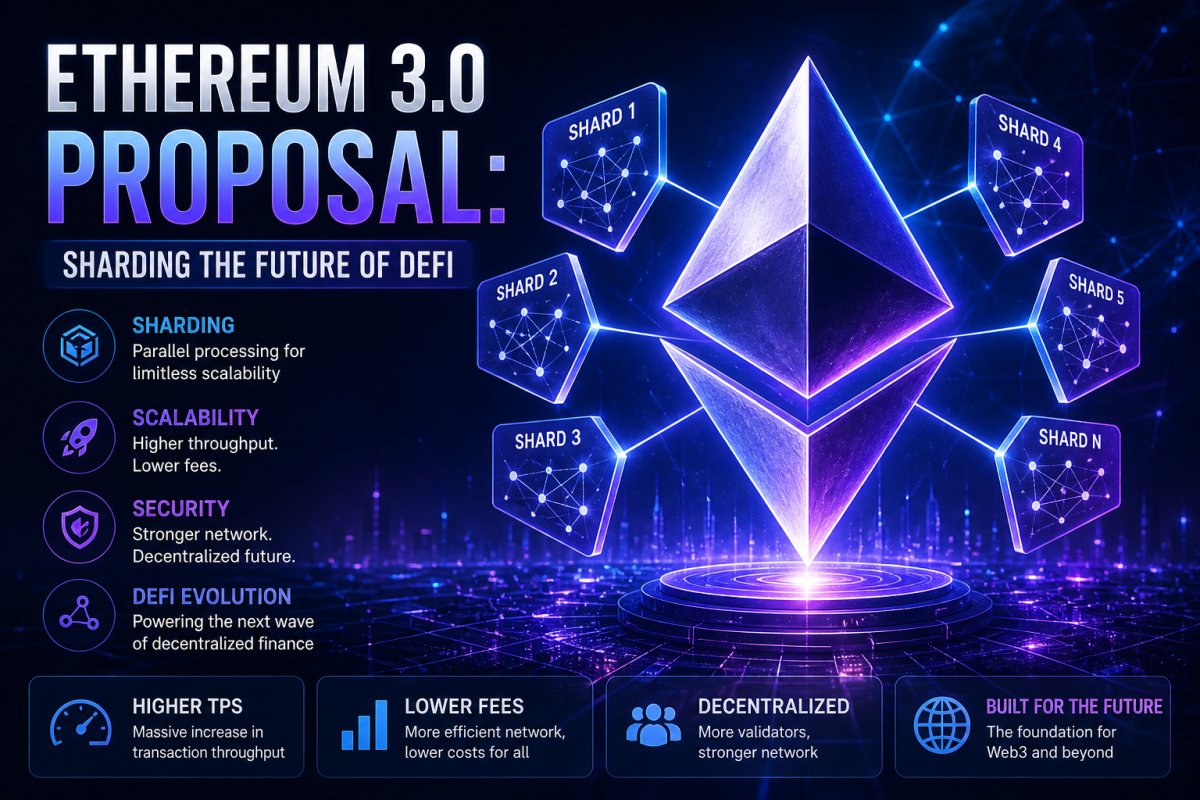
Ethereum 3.0 Proposal: Sharding the Future of DeFi
While the 2022 "Merge" and the 2024 "Dencun" upgrade laid the groundwork for scalability, the Ethereum 3.0 Proposal—gaining massive traction in mid-2026—represents the final move toward a truly global, decentralized financial computer. As institutional migration toward
The Architecture: Execution Sharding vs. Data Sharding
The core of the 3.0 proposal is the transition from "Danksharding" (which optimized data for Layer 2s) to Native Execution Sharding.
-
Parallel Processing: Instead of every node validating every transaction, the network is split into "shards." Each shard can process its own set of smart contracts and transactions in parallel.
-
The Beacon Layer 2.0: The central coordination chain is being upgraded to handle cross-shard communication with sub-second finality, ensuring that a DeFi trade on Shard A can interact with a liquidity pool on Shard B instantly.
-
Zero-Knowledge (ZK) Everything: Ethereum 3.0 integrates ZK-SNARKs at the protocol level. This allows nodes to verify the state of the entire blockchain by checking a tiny mathematical proof, rather than downloading hundreds of terabytes of data.
Impact on DeFi and Global Finance
The upgrades proposed for 2026 are specifically designed to handle the load of global banking systems.
-
Gas Fee Elimination: For the average user, gas fees are expected to drop to sub-cent levels, making micro-transactions viable for the first time on the mainnet.
-
Institutional Security: With the rise of
Deepfake and AI-driven threats -
High-Frequency Trading: The reduction in block latency allows for on-chain order books that can compete with centralized exchanges, a necessity as
Bitcoin hits the $120k milestone
Ethereum 3.0 Technical Milestone Roadmap
| Phase | Technical Focus | 2026 Status |
| The Splurge | EVM (Ethereum Virtual Machine) Optimization | Active Testing |
| The Verge | Verkle Trees & Statelessness | Mainnet Deployment |
| Execution Sharding | Parallel Smart Contract Processing | Testnet Launch |
| ZK-Integration | Protocol-level SNARKs | Proposal Stage |
The Synergy with AI and Edge Computing
Following the
-
AI-to-AI Transactions: The new architecture supports lightning-fast, low-cost payments between autonomous AI agents.
-
Edge Validation: Much like the
Node.js 2026 Roadmap
The Verdict: A New Financial Backbone
Ethereum 3.0 isn't just an update; it’s a re-engineering of the internet’s value layer. For developers and business managers at entities like M/S Mizpah Services, it provides the infrastructure to build global apps that are as fast as a centralized database but as secure as a decentralized network.
As
What's Your Reaction?
 Like
0
Like
0
 Dislike
0
Dislike
0
 Love
0
Love
0
 Funny
0
Funny
0
 Wow
0
Wow
0
 Sad
0
Sad
0
 Angry
0
Angry
0















Comments (0)