

India's 6G Roadmap: DOT Confirms Initial Test Cities
India's 6G Roadmap: DOT Confirms Initial Test Cities, detailing technical specs, market trends, and 2026 predictions.
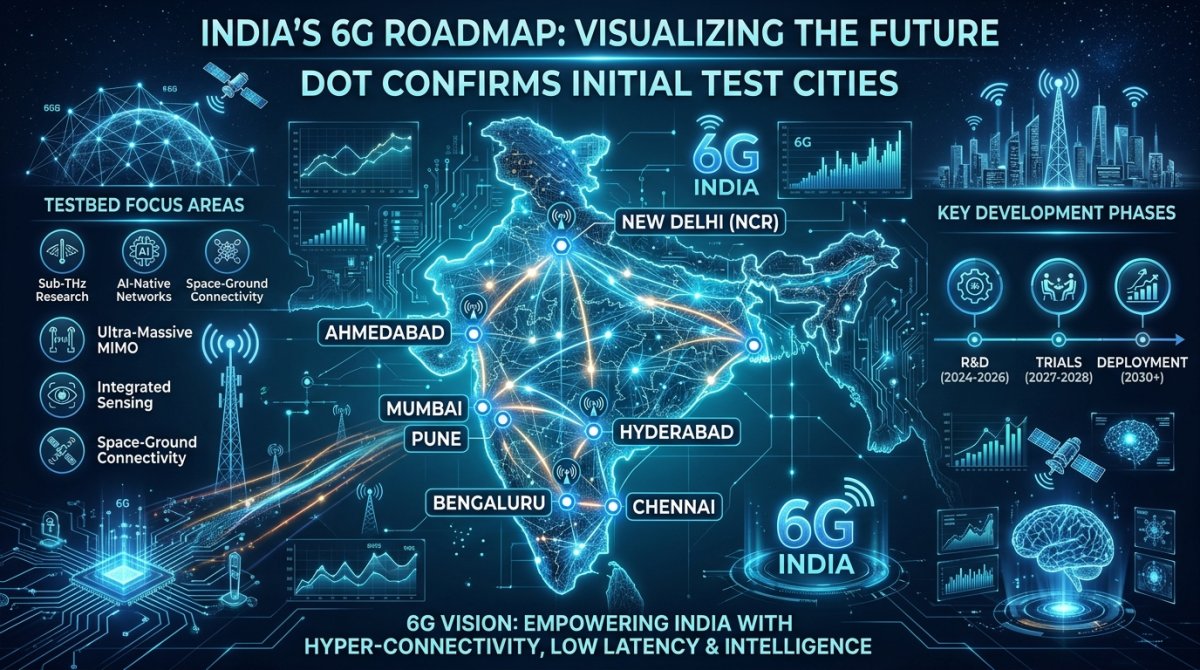
India's 6G Roadmap: DOT Confirms Initial Test Cities
The Department of Telecommunications (DOT) has officially unveiled the first phase of India’s 6G roadmap, marking a transition from the hyper-speed 5G era to the "Tera-bit" future. As
The Initial Test Cities: Phase 1 Rollout
The DOT has selected six "Innovation Hubs" for the initial 6G testbeds. These cities were chosen based on their existing fiber density, 5G penetration, and proximity to premier research institutions.
-
Bengaluru & Mysore: The "Silicon Valley" and its neighboring heritage city will serve as the primary hub for 6G Core software development, leveraging the local expertise in
Node.js Edge performance -
Hyderabad: Focused on the development of 6G hardware and semiconductor integration, specifically testing the compatibility of
2nm chip architecture -
Chennai: Testing "Marine 6G" applications for port automation and high-speed maritime communication.
-
Delhi-NCR: The center for 6G policy, regulatory testing, and large-scale urban density simulations.
-
Pune: Dedicated to 6G-enabled automotive AI and V2X (Vehicle-to-Everything) communication.
What 6G Means for the 2026 Digital Economy
While 5G focused on video streaming and basic IoT, 6G is designed for Cyber-Physical Systems—the seamless merging of the physical and digital worlds.
-
Holographic Communication: 6G will provide the bandwidth required for real-time 3D holographic calls, moving beyond the video-conferencing limits seen in 2026.
-
Sensing-as-a-Service: The network itself will act as a radar, capable of detecting objects, weather patterns, and even human gestures without separate sensors.
-
Ubiquitous Connectivity: Through the integration of Starlink-like satellite constellations and terrestrial towers, 6G aims for "zero-dead-zone" coverage, essential for missions like the
SpaceX 2026 Mars Prep
The 6G Technical Specification Targets
| Feature | 5G (Current Standard) | 6G (2026+ Targets) |
| Peak Data Rate | 10 - 20 Gbps | 1 Tbps (Terabit per second) |
| Latency | 1 - 5 Milliseconds | < 0.1 Milliseconds |
| Connection Density | 1 Million devices / sq. km | 10 Million devices / sq. km |
| Spectrum Usage | Sub-6GHz & mmWave | Terahertz (THz) Frequencies |
| AI Integration | Add-on feature | Native "AI-at-the-Core" |
Security Challenges: The Deepfake Era
With speeds hitting 1 Tbps, the risk of high-fidelity data manipulation rises. The DOT has emphasized that 6G infrastructure must include native defenses against
The Bharat 6G Vision
India currently holds over 200 patents in 6G technology. The government’s goal is to ensure that by the time global 6G standards are finalized in 2029-2030, the "Indian Stack" is the primary blueprint used by the world.
For business managers at entities like M/S Mizpah Services, this roadmap suggests that the next five years will be defined by an explosion in automation and real-time monitoring capabilities that go far beyond current 5G limits.
What's Your Reaction?
 Like
0
Like
0
 Dislike
0
Dislike
0
 Love
0
Love
0
 Funny
0
Funny
0
 Wow
0
Wow
0
 Sad
0
Sad
0
 Angry
0
Angry
0













Comments (0)