

What Is Edge AI? Beginner-Friendly Guide to On-Device Intelligence (2026)
Edge AI means artificial intelligence that runs directly on your device – not in a distant cloud server. In 2026, this shift is making your phone faster, your privacy stronger, and your smart devices actually smart. This beginner’s guide explains how it works, why it matters, and where it’s heading.
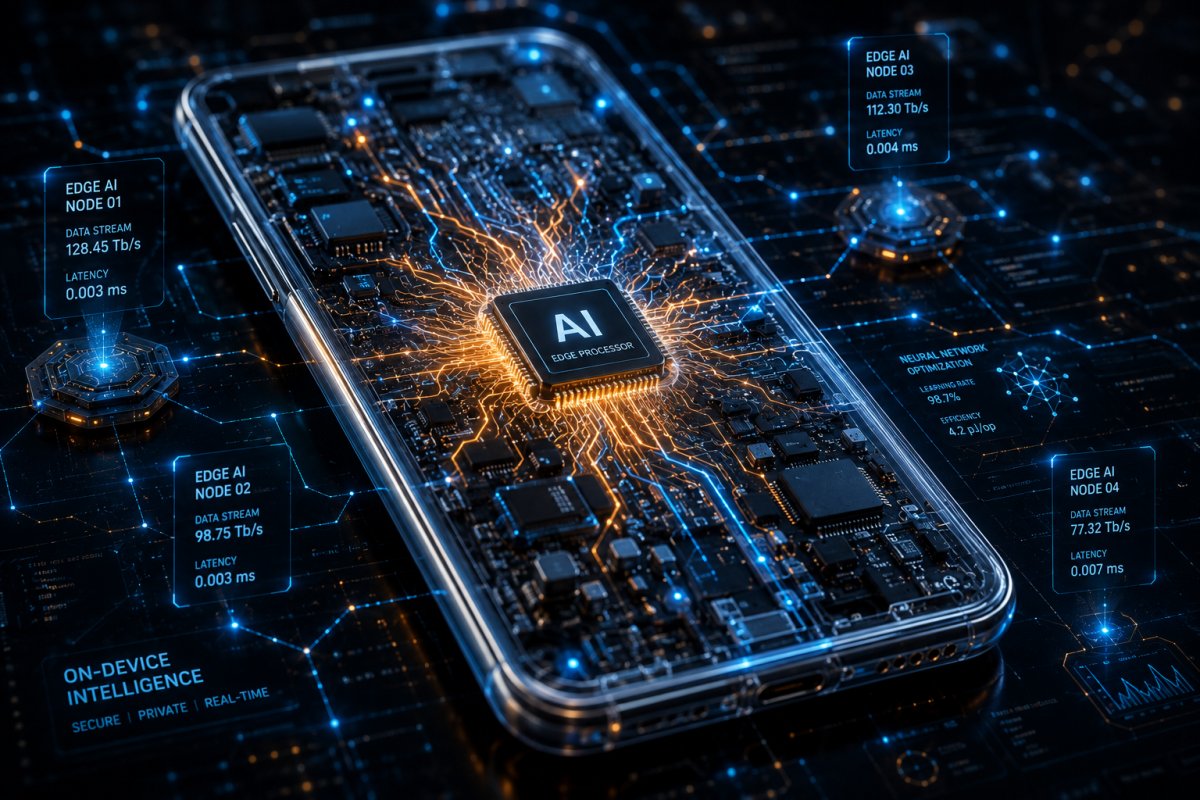
What Is Edge AI? Beginner-Friendly Guide to On‑Device Intelligence (2026)
Your phone just translated a sign in real time – without an internet connection. Your smartwatch detected an irregular heartbeat – without sending data to a server. Your robot vacuum navigated a messy room – without asking for help.
Ten years ago, those tasks would have required a round trip to the cloud. Today, they happen right where the data is created: at the edge.
Welcome to Edge AI. And if you’ve used any modern smartphone, smart home gadget, or wearable in 2026, you’ve already experienced it. Let me explain what it actually is, why it’s quietly becoming the biggest shift in artificial intelligence since the transformer model, and why you should care – even if you don’t consider yourself a tech person.
The Simple Analogy: Cooking at Home vs. Takeout
Imagine you want dinner.
-
Cloud AI (traditional) = ordering takeout. You send your request over the internet, a restaurant prepares your food, and it gets delivered. It works great, but takes time, costs delivery fees, and someone else handles your ingredients (privacy risk). If the restaurant is busy (server load) or the delivery driver gets stuck (network lag), you wait.
-
Edge AI = cooking at home. Your ingredients never leave your kitchen. You decide exactly what goes into the dish. It’s faster (no delivery wait), more private (no one sees what you’re making), and works even if the power is out (no internet needed) – as long as you have the right tools (an AI chip) and skills (the model).
In 2026, we’ve reached a point where the “kitchen” in your pocket – your phone, your car, your security camera – is nearly as capable as a high‑end restaurant cloud. For many tasks, cooking at home is simply better.
What Actually Is Edge AI? (No Jargon, I Promise)
Edge AI = artificial intelligence models that run directly on a device (the “edge” of the network), rather than sending data to a remote cloud server.
The device could be:
-
Your smartphone
-
A smart speaker (Amazon Echo, Google Nest)
-
A security camera with facial recognition
-
A self‑driving car’s onboard computer
-
A factory robot
-
A medical sensor patch
The “AI” part is typically a trained model – like a face detector, a language translator, or a voice command recogniser. That model lives on the device permanently. When you use it, everything processes locally. No upload, no waiting, no third‑party server.
Cloud vs. Edge: The 2026 Reality Check
| Feature | Cloud AI | Edge AI |
|---|---|---|
| Speed | 100–500ms round trip | 1–10ms (instant) |
| Internet needed? | Yes, always | No |
| Privacy | Data leaves your device | Data stays local |
| Cost | Ongoing (server time, bandwidth) | Once (device chip) |
| Works offline? | No | Yes |
| Battery drain | Low (device does little) | Higher (device computes) |
| Updates | Easy (server side) | Requires device firmware updates |
Cloud AI isn’t going away. Complex tasks (training huge models, analysing years of data, generating long text) still benefit from cloud resources. But for real‑time, private, always‑available intelligence? Edge AI is winning.
The Brains Inside: AI Chips (NPUs)
You can’t run a powerful AI model on a standard processor – it would drain your battery in 20 minutes. That’s why every serious edge device now includes a dedicated NPU (Neural Processing Unit).
Think of an NPU as a calculator designed only for the math that AI models use – mainly matrix multiplication and convolution. It does those calculations 100x more efficiently than a general‑purpose CPU.
Examples you might own:
-
Apple’s Neural Engine (in iPhone 16–18 series) – up to 40 TOPS (trillion operations per second)
-
Google Tensor G5 (Pixel 11) – custom NPU for Gemini Nano
-
Qualcomm Hexagon (Snapdragon 8 Gen 5) – supports running multiple AI models simultaneously
-
MediaTek APU (Dimensity 9500) – focused on power efficiency
In 2026, even mid‑range phones have NPUs. You don’t need a “Pro” model for basic on‑device AI.
Where You Already Use Edge AI Every Day
Let me show you five practical examples you’ve probably used without realising.
1. Your Smartphone Camera
When you take a portrait mode photo, your phone’s NPU identifies the person, separates them from the background, and applies blur – all in milliseconds. No internet required. Google’s “Best Take” (which fixes closed eyes) and Samsung’s “Object Eraser” now run entirely on‑device in 2026.
2. Live Voice Transcription
Recording a meeting or lecture? Apps like Otter.ai and Apple’s Voice Memos now transcribe in real time without sending audio to the cloud. The model runs on your NPU. Privacy win: your conversation never leaves your phone.
3. Smart Home Cameras
A $50 security camera in 2026 can detect a person, a package, or a pet – locally. It only sends a short clip to the cloud when something actually happens. No more false alerts from shadows or bugs. That local detection is Edge AI.
4. Keyboard Prediction
Your phone’s keyboard suggests the next word. In 2026, that model is personalised to your typing style and runs entirely on your device. No one (not even the keyboard company) sees what you type.
5. Fitness Watches
An Apple Watch or Garmin can detect a fall or irregular heartbeat without a phone connection. The AI model for motion pattern recognition lives inside the watch. That split‑second decision can save a life – even in a tunnel with no signal.
Robotics: Where Edge AI Gets Really Exciting
A self‑driving car cannot wait for a cloud response. If a child runs into the street, the car must react in 50 milliseconds. Cloud round trips take 100ms+.
All autonomous vehicles – from Tesla to Waymo – use Edge AI for perception (what is that object?), prediction (will it move?), and planning (brake or swerve?). The cloud handles high‑level route planning and fleet learning, but the life‑critical decisions happen at the edge.
Similarly, warehouse robots (Amazon, Alibaba) use on‑device AI to avoid collisions and grab items. Factory robots now learn new tasks through “few‑shot learning” on the edge – no need to reprogram a central server every time.
Privacy Advantages: The Silent Killer Feature
Here’s why privacy experts love Edge AI: data never leaves your device.
Think about a smart doorbell. In 2020, most sent every video frame to the cloud for analysis. That meant a stranger’s server saw everyone who walked past your house. In 2026, high‑end doorbells run facial recognition locally. Only when you specifically request a clip does anything leave your home.
Real‑world impact: Apple’s “Private Cloud Compute” (for Apple Intelligence in 2025–26) tries to keep as much as possible on‑device. Google’s Gemini Nano is now the default for Pixel phones. Microsoft’s Copilot can run locally on Snapdragon laptops.
For the average user, this means less creepy targeted ads (no one sees your conversations), fewer data breaches (nothing to steal), and no need to trust “big tech” with your daily life.
The Trade‑Offs (Balanced Analysis)
Edge AI isn’t magic. It has real limitations.
Challenge 1: Model size
A powerful AI model like GPT‑4o is hundreds of billions of parameters. That’s several hundred gigabytes. No phone can store that. Edge models are smaller, lighter, and therefore less capable. You get speed and privacy, but you lose raw power.
Challenge 2: Battery life
Running an NPU drains battery faster than idle – though newer chips are incredibly efficient. In 2026, heavy Edge AI use (constant voice transcription + live translation) shaves about 15–20% off a typical day. Acceptable for most, but not a free lunch.
Challenge 3: Update difficulty
Cloud models improve constantly – you never notice updates. Edge models require a device firmware update, which manufacturers are reluctant to push often. Your phone’s AI might be “frozen in time” six months after purchase.
Challenge 4: Fragmentation
Not all edge devices are equal. A cheap smart plug has a tiny NPU that can barely detect a clap. A flagship phone can run generative AI. Developers have to build multiple versions of their models – frustrating and slow.
Future Industry Applications (2027–2030)
Here’s what’s coming next:
Healthcare wearables – Sensors that detect early signs of sepsis or heart failure locally, alerting you before symptoms appear. No cloud needed, so they work anywhere.
Augmented reality glasses – Real‑time object recognition, language translation overlaid on the real world, and face recall (remembering names) – all running on glasses, not a phone.
Smart agriculture – Drones that identify diseased crops in real time using on‑board Edge AI, then spray only affected plants. No internet in the middle of a farm? No problem.
Personal robots – Not just Roombas, but home assistant robots that learn your floor plan and preferences locally. Your robot shouldn’t upload a map of your house to a company server.
Automotive – Cars that negotiate with each other at intersections using vehicle‑to‑vehicle Edge AI, without any central traffic computer. Safer, lower latency.
Frequently Asked Questions (FAQs)
1. Is Edge AI the same as on‑device AI?
Yes – they’re used interchangeably. “Edge” emphasises the network edge (where data is created), while “on‑device” specifically means your phone or gadget.
2. Do I need special hardware for Edge AI?
For basic tasks (face unlock, voice wake words), commodity processors are enough. For anything advanced (live translation, generative AI), you need a device with an NPU. Most 2026 smartphones have them – check your specs for “Neural Engine,” “NPU,” or “AI accelerator.”
3. Is Edge AI more secure than cloud AI?
Generally, yes – because your data never leaves your device, there’s no transmission to intercept and no server to hack. However, if your device itself is compromised (malware), Edge AI doesn’t help. So keep your phone updated.
4. Can Edge AI work with cloud AI together?
Absolutely – this is called “distributed AI” or “hybrid AI.” Your device handles simple, urgent tasks locally. Complex or rare tasks get offloaded to the cloud. For example, your phone recognises your face (edge), but asks the cloud to identify an obscure bird species from a photo.
5. Will Edge AI replace cloud AI?
No – they complement each other. Cloud AI is still essential for training large models (since cloud servers have thousands of chips working together) and for tasks that require massive knowledge bases (like answering obscure historical questions). Edge AI handles the moment‑to‑moment intelligence.
6. How do I know if an app is using Edge AI?
Look for privacy labels (“processes data on device”) or offline functionality. Apps that work without internet (like offline translation in Google Translate) are using Edge AI. Apps that require constant “uploading” are using cloud AI.
Balanced Analysis: Not Every Problem Needs Edge AI
I’ll be honest – not every AI task belongs on the edge. If you’re asking a chatbot to write a 2,000‑word essay, cloud AI (with its massive models) will do a much better job. If you’re searching a database of millions of documents, the cloud’s storage and compute win.
Edge AI excels at:
-
Speed‑critical tasks (braking a car)
-
Privacy‑sensitive tasks (health, conversations)
-
Always‑available tasks (offline use)
-
Low‑cost, high‑frequency tasks (keyboard predictions)
Cloud AI still leads at:
-
Creative generation (long text, images)
-
Training (teaching models)
-
Massive knowledge retrieval
-
Collaborative analysis (across millions of users)
The smartest systems in 2026 decide dynamically – run locally if possible, ask the cloud if necessary. You don’t see the handoff. You just get fast, private, powerful AI.
Conclusion: The Quiet Revolution in Your Pocket
Edge AI isn’t a futuristic concept. It’s the reason your phone understands “Hey Google” instantly, your watch detects a fall without a signal, and your doorbell politely ignores the neighbour’s cat.
By 2026, the technology has matured to the point where most new devices include an NPU. The benefits – speed, privacy, offline availability – are no longer theoretical. They’re everyday experiences.
But here’s the bigger picture: Edge AI shifts power from cloud giants back to device owners. Your data stays yours. Your intelligence stays with you. The cloud becomes a helper, not a controller.
That doesn’t mean cloud AI is evil – far from it. But for the first time, we have a genuine choice. Need a deep, creative answer? Ask the cloud. Need a fast, private, always‑ready assistant? Your pocket is ready.
And the best part? You don’t need to understand the matrix math to benefit. You just need a modern device and an app that respects your privacy.
Edge AI is here. And it works quietly, quickly, and without asking for permission.
What's Your Reaction?
 Like
0
Like
0
 Dislike
0
Dislike
0
 Love
0
Love
0
 Funny
0
Funny
0
 Wow
0
Wow
0
 Sad
0
Sad
0
 Angry
0
Angry
0


Comments (0)