

Node.js 2026 Roadmap: Optimizing for Edge Computing Performance
Node.js 2026 Roadmap: Optimizing for Edge Computing Performance, covering tactical analysis, future trends, and expert insights for 2026.
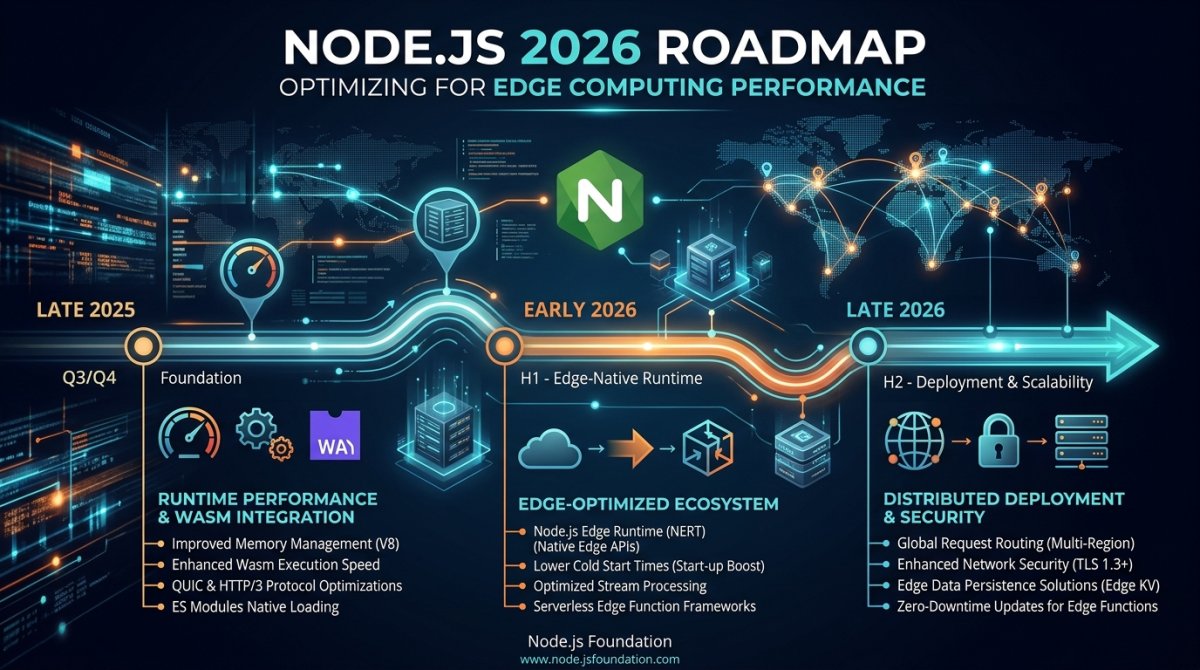
ode.js 2026 Roadmap: Optimizing for Edge Computing Performance
As we move through 2026, Node.js has undergone a significant transformation to maintain its dominance in the backend world. With the surge in
The 2026 roadmap reflects this shift, prioritizing startup speed, memory efficiency, and seamless integration with modern hardware like the
1. Zero-Delay Cold Starts with Built-in Snapshots
In the Edge environment, "Cold Starts" are the enemy of performance. Node.js 2026 has introduced native support for V8 Startup Snapshots out of the box.
-
The Tech: Developers can now "serialize" the state of their application after the initial boot and save it as a snapshot.
-
The Benefit: When a request hits an Edge function, Node.js loads the snapshot instead of parsing all the JavaScript from scratch, reducing startup time by up to 80%.
-
Use Case: Perfect for high-traffic events like the
IPL 2026 Playoffs
2. Native WebAssembly (Wasm) Integration
Node.js has evolved to treat WebAssembly as a first-class citizen. This is crucial for CPU-intensive tasks that were previously too slow for JavaScript.
-
Hardware Acceleration: Node.js now automatically optimizes Wasm execution for the latest instruction sets, including those used in
NVIDIA’s Quantum-AI Hybrid Models -
Forensic Applications: This allows for lightning-fast forensic data extraction and complex cryptographic operations directly within the Node.js runtime without needing external C++ addons.
3. Enhanced Security: Permission Model 2.0
Security is a top priority as apps face increasingly sophisticated
-
Granular FS Access: You can now restrict a Node.js process to read-only access for specific directories at the runtime level (e.g.,
--allow-fs-read=/data/logs). -
Network Sandboxing: Restrict which outbound URLs your Edge function can talk to, preventing data exfiltration if a dependency is compromised.
4. Built-in Multiagent Coordination
Following the
-
Worker Thread Orchestration: A new
AgentChannelAPI allows multiple Worker Threads to communicate with lower overhead, making it easier to build "Self-Healing" systems. -
Edge Monitoring: These agents can autonomously monitor system health, similar to the MonitorPro dashboards, and trigger auto-scaling events before a server hits its limit.
5. Roadmap Summary: Node.js 2026 at a Glance
| Feature | Primary Goal | Target Environment |
| V8 Snapshots | Sub-10ms Startup | Edge / Serverless |
| Wasm-First Runtime | High-Performance Math | AI / Forensic Tools |
| Runtime Permissions | Zero-Trust Security | Enterprise Apps |
| QUIC & HTTP/3 | Reduced Latency | Mobile / Global Apps |
The Verdict
The 2026 roadmap proves that Node.js is no longer just for web servers; it is a specialized tool for the Edge Revolution. By optimizing for startup speed and hardware-level performance, it remains the backbone of the digital economy, handling everything from
What's Your Reaction?
 Like
0
Like
0
 Dislike
0
Dislike
0
 Love
0
Love
0
 Funny
0
Funny
0
 Wow
0
Wow
0
 Sad
0
Sad
0
 Angry
0
Angry
0










Comments (0)