

SpaceX Starship 2026: First Manned Mars Flyby Prep
SpaceX Starship 2026: First Manned Mars Flyby Prep, detailing technical specs, market trends, and 2026 predictions.
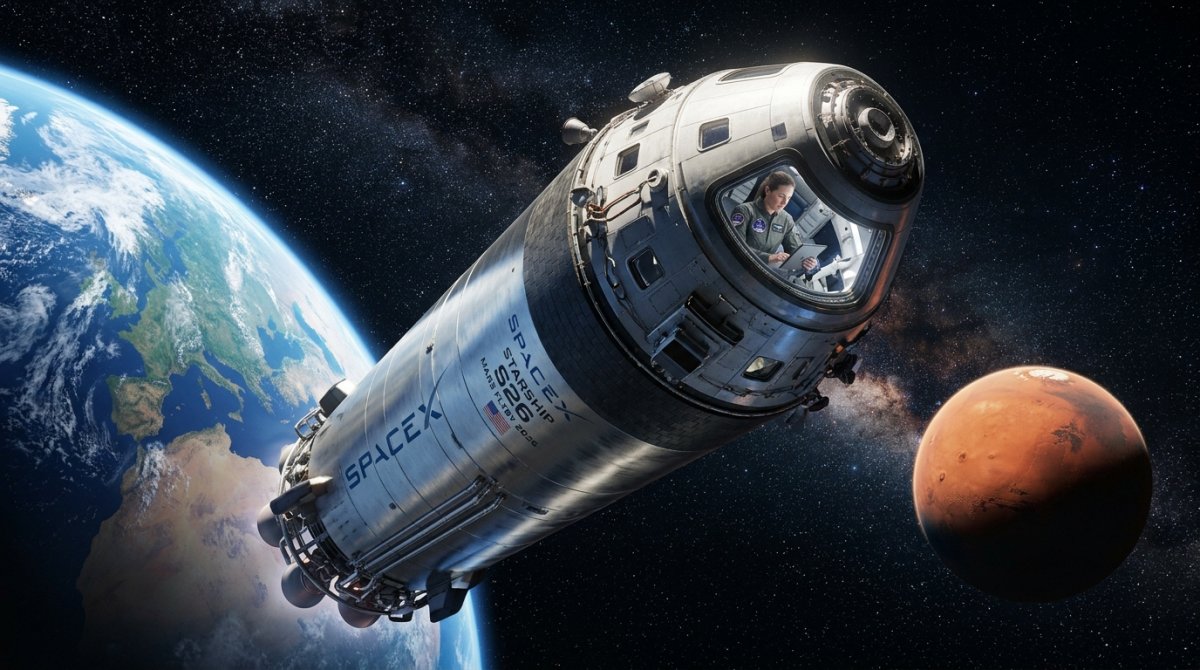
SpaceX Starship 2026: First Manned Mars Flyby Prep
As 2026 marks a pivotal launch window for Mars, SpaceX has accelerated its "Multiplanetary Species" roadmap. The current focus is the final preparation for a Manned Mars Flyby, a high-stakes mission designed to test life support systems and deep-space radiation shielding before an eventual landing attempt. Following the record-breaking success of the
The 2026 Launch Window: Why Now?
Orbital mechanics dictate that the most fuel-efficient journey to Mars occurs once every 26 months. The 2026 window is particularly significant because it aligns with the deployment of the Starship HLS (Human Landing System) variant, which has already undergone rigorous testing in lunar orbit.
-
In-Orbit Refueling: The mission’s success hinges on "Ship-to-Ship" propellant transfer. SpaceX has successfully demonstrated the transfer of cryogenic liquid oxygen and methane in low Earth orbit, a technical hurdle that was previously considered insurmountable.
-
Radiation Shielding: 2026 models of the Starship include a "Storm Cellar"—a high-density water-shielded area where the crew can retreat during solar flare events.
-
Life Support (ECLSS): The Environmental Control and Life Support System is now rated for 500+ days of autonomous operation without resupply, utilizing advanced recycling loops for water and oxygen.
Technical Specifications: Starship 2026 Model
| Component | Specification | Function |
| Height | 121 Meters (Ship + Booster) | Total Launch Vehicle Stature |
| Thrust | 7,500+ Tons (33 Raptor 3 Engines) | Lift-off from Super Heavy Booster |
| Payload | 100 - 150 Tons (Fully Reusable) | Scientific Cargo & Crew Supplies |
| Heat Shield | Generation-3 PICA-X Tiles | Protection during Mars & Earth Entry |
| Communication | Integrated Starlink Laser Link | High-speed data relay across Deep Space |
The Mission Roadmap: 2026 - 2027
The Starship mission is not a direct landing but a "Free Return Trajectory." If any systems fail during the outbound journey, the spacecraft’s momentum will naturally swing it around Mars and back toward Earth.
-
Launch Phase: The Super Heavy Booster lofts the Starship into a parking orbit.
-
The Tanker Fleet: Five "Tanker" Starships launch in rapid succession to refill the main Mars-bound vessel.
-
Trans-Mars Injection (TMI): The ship fires its six Raptor engines to exit Earth’s gravity well.
-
The Flyby: The crew will pass within 200 kilometers of the Martian surface, deploying autonomous probes to scan potential landing sites for the 2028 window.
The Digital Backbone of the Mission
Managing a mission of this scale requires unprecedented data processing. SpaceX is utilizing
The Global Impact
With
As we look toward the 2026 launch, the question is no longer "if" humans will reach Mars, but "how soon" we will see the first high-definition 8K stream from the Red Planet.
What's Your Reaction?
 Like
0
Like
0
 Dislike
0
Dislike
0
 Love
0
Love
0
 Funny
0
Funny
0
 Wow
0
Wow
0
 Sad
0
Sad
0
 Angry
0
Angry
0















Comments (0)